




This article summarizes publicly reported minimum-wage figures and the standard 209-hour monthly calculation. Actual take-home pay may vary by employment type, deductions, and insurance contributions.
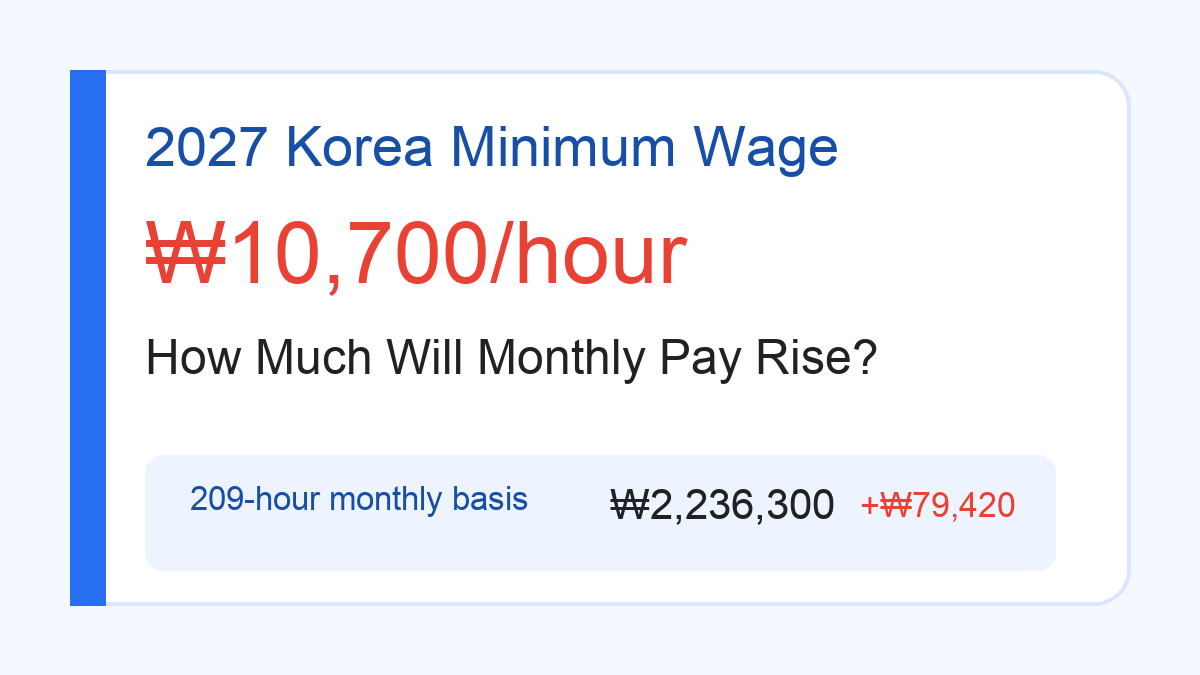
2027 Korea Minimum Wage: How Much Will Monthly Pay Rise?
The 2027 Minimum Hourly Wage Has Finally Been Set at 10,700 Won
The 2027 minimum hourly wage has been set at 10,700 won per hour.
This is an increase of 380 won from this year's rate of 10,320 won. The increase rate is 3.7%.
Looking only at the numbers, you might wonder, "Is a 380 won increase a big difference?" However, when calculated based on a monthly salary, including 8 hours a day, 5 days a week, and weekly paid holiday allowance, the story changes a bit.
The monthly salary difference is approximately 79,000 won. Over a year, this amounts to about 950,000 won.
For those who earn wages close to the minimum wage, such as convenience store workers, cafe staff, restaurant employees, office assistants, or short-term part-timers, this is a change worth calculating in advance.
2027 Minimum Wage: Key Figures at a Glance
| Category | 2026 | 2027 | Difference |
|---|---|---|---|
| Minimum Hourly Wage | 10,320 won | 10,700 won | +380 won |
| Increase Rate | - | 3.7% | - |
| Monthly Salary Conversion | 2,156,880 won | 2,236,300 won | +79,420 won |
| Simple Annual Difference | - | - | +953,040 won |
The monthly salary conversion is based on 209 hours per month, including weekly paid holiday allowance.
Many minimum wage articles use this calculation method. The actual amount deposited into your bank account may vary depending on the Four Major Insurances, income tax, and employment type.
Why is it calculated based on 209 hours per month?
209 hours is a number that frequently appears in minimum hourly wage monthly salary calculations.
Based on an 8-hour day, 5-day work week, and including weekly paid holiday hours, the average monthly paid hours are calculated as 209 hours.
Therefore, the 2027 minimum hourly wage monthly salary is calculated as follows:
10,700 won × 209 hours = 2,236,300 won
The 2026 standard is as follows:
10,320 won × 209 hours = 2,156,880 won
The difference between the two amounts is 79,420 won.
Looking at it monthly, it might feel like enough for a few meals out, some transportation costs, or part of a phone bill. Over 12 months, it's 953,040 won.
Viewed annually, it's certainly not a small amount to overlook.
What Actually Changes for Part-time Workers
If you work close to the minimum hourly wage, you'll need to review your 2027 employment contract.
If your hourly wage is listed as less than 10,700 won, it's an issue. You should also check the probationary period, short-time work, and conditions for weekly paid holiday allowance.
The weekly paid holiday allowance is a particularly confusing part of part-time wage calculations.
If you work 15 hours or more per week and complete your scheduled workdays, you may be entitled to weekly paid holiday allowance. Simply calculating `hours worked × hourly wage` might result in receiving less than the actual amount you should get.
There are three things to check:
- Is the hourly wage stated in your employment contract 10,700 won or more?
- Do you meet the conditions for weekly paid holiday allowance?
- What is your net pay after the Four Major Insurances deductions?
Even if your monthly salary increases, you shouldn't assume your net pay will increase by exactly 79,420 won. Deduction items may also change.
Business Owners Need to Recalculate Labor Costs
For those operating a business, 380 won might not seem small.
For one employee, it's a difference of 79,420 won per month. If you have 5 employees, it could lead to a monthly labor cost increase in the 390,000 won range, and for 10 employees, it could be in the 790,000 won range.
The burden becomes clearer when viewed annually.
| Number of Employees | Additional Monthly Burden | Additional Annual Burden |
|---|---|---|
| 1 person | 79,420 won | 953,040 won |
| 5 people | 397,100 won | 4,765,200 won |
| 10 people | 794,200 won | 9,530,400 won |
Of course, actual labor costs vary depending on working hours, weekly paid holiday allowance, the employer's share of the Four Major Insurances, night shift allowance, and overtime allowance.
Nevertheless, it's safer to review your monthly labor cost budget before the 2027 minimum wage takes effect.
Most Confusing Aspects of the 2027 Minimum Hourly Wage
The first is pre-tax versus after-tax.
2,236,300 won is the pre-tax monthly salary. The actual deposited amount will be lower after deductions for National Pension, Health Insurance, Employment Insurance, income tax, etc.
The second is that not everyone's salary is calculated based on 209 hours per month.
While 209 hours is used for the typical monthly salary conversion based on a 40-hour work week, calculations for part-time or short-term work vary depending on actual working hours and weekly paid holiday allowance conditions.
The third is that an increase in the minimum hourly wage does not necessarily lead to an increase in all wages.
If you are already receiving an hourly wage higher than the minimum wage, whether your wage increases depends on the wage policy of your company or workplace.
How Does the 2027 Minimum Wage Feel Compared to 2026?
The 2026 minimum hourly wage was 10,320 won.
In 2027, it will be 10,700 won, a difference of 380 won per hour.
Based on an 8-hour day, this is a difference of 3,040 won per day.
380 won × 8 hours = 3,040 won
With a simple calculation for a 5-day work week, it's a difference of 15,200 won per week.
Based on monthly salary, as calculated earlier, it's a difference of 79,420 won.
Viewed narrowly, it might seem like less than the price of a cup of coffee per day. Viewed broadly, it's about 950,000 won over a year.
Therefore, rather than judging the minimum hourly wage solely by the hourly rate, it's important to consider the monthly salary, annual amount, and actual working conditions together.
What Employees Should Check
Before 2027 begins, it's a good idea to check the following items:
- Is the hourly wage in your new employment contract 10,700 won or more?
- Do you meet the conditions for weekly paid holiday allowance?
- If you are on a monthly salary, does your basic pay exceed the minimum wage standard?
- Are night, overtime, and holiday work allowances calculated separately?
- Have you separately calculated your net pay after the Four Major Insurances deductions?
Monthly salaried employees, in particular, might easily dismiss this, thinking, "I'm not paid hourly, so it doesn't concern me."
Monthly salaries must also meet the minimum wage standard. The calculation can vary depending on the basic pay and fixed allowance structure, so it's advisable to review your payslip.
What Business Owners Should Check
From a business owner's perspective, 2027 labor costs should be factored in advance.
- Re-evaluate working hours for each employee
- Calculate labor costs including weekly paid holiday allowance
- Reflect the employer's share of the Four Major Insurances
- Identify frequent night and overtime work hours
- Review the necessity of adjusting menu prices, operating hours, and work schedules
When the minimum wage increases, it's not just a matter of changing the hourly rate.
Weekly paid holiday allowance, various other allowances, and insurance premiums can all be affected. Especially for businesses with many employees, it's better to look at the burden on a quarterly or annual basis rather than monthly for a more accurate assessment.
2027 Minimum Wage FAQ
Q1. What is the 2027 minimum hourly wage?
The 2027 minimum hourly wage is 10,700 won per hour. This is an increase of 380 won from 10,320 won in 2026, with an increase rate of 3.7%.
Q2. What is the 2027 minimum hourly wage monthly salary?
It is 2,236,300 won pre-tax, based on 209 hours per month. This is the standard conversion method including a 40-hour work week and weekly paid holiday hours.
Q3. How much will the monthly salary increase compared to 2026?
The 2026 monthly salary conversion was 2,156,880 won. Compared to the 2027 standard, it increases by 79,420 won per month.
Q4. What is the annual difference in salary?
Simply calculating the monthly difference of 79,420 won over 12 months results in 953,040 won. However, this is the amount before taxes and Four Major Insurances deductions.
Q5. Is part-time work also calculated based on 209 hours per month?
No. 209 hours per month is based on a 40-hour work week. Part-time work must be calculated separately based on actual working hours and weekly paid holiday allowance conditions.
Q6. Will the net pay also increase by exactly 79,420 won?
Not necessarily. 2,236,300 won is the pre-tax amount. The actual deposited amount after deductions for the Four Major Insurances and taxes will vary depending on individual circumstances.
Conclusion: Look at the Monthly Salary, Not Just the 380 Won Hourly Increase
The 2027 minimum hourly wage is 10,700 won.
An increase of 380 won per hour might seem small. However, it's a difference of 79,420 won per month, and approximately 950,000 won annually.
Employees should check their employment contracts and weekly paid holiday allowance conditions.
Business owners should recalculate their 2027 labor cost budget.
The minimum wage is not just a news item about a single number. You need to calculate how your monthly salary, part-time wages, and store operating costs will actually change to truly feel the impact.
#2027Koreaminimumwage #Koreaminimumwage2027 #minimumwageKorea #10700wonminimumwage #Koreanlaborlaw #monthlysalaryKorea #part-timejobsKorea #weeklyholidayallowance #209hourssalarycalculation #Koreawageincrease #employmentinKorea #Koreaneconomy #salarycalculation #smallbusinesslaborcost #livingeconomy