




Ebola may seem like a problem limited to distant parts of Africa, but in an era of air travel and cross-border movement, it is important to check overseas infectious disease information promptly. The Bundibugyo Ebola disease confirmed in the Democratic Republic of the Congo and Uganda in May 2026 has been assessed by the World Health Organization as a public health emergency of international concern.
2026 Central Africa Ebola Resurgence: Bundibugyo Outbreak Status, Symptoms, and Travel Precautions
This Ebola outbreak began in the eastern Democratic Republic of the Congo, and confirmed cases have also been identified in Uganda. The causative virus is Bundibugyo virus, a type that is being described as having no approved vaccine or specific treatment, unlike the existing Zaire ebolavirus type.
A situation that must be checked before travel
If you plan to visit eastern Democratic Republic of the Congo, Uganda, or neighboring countries, check the latest travel advisories and overseas infectious disease guidance from the Korea Disease Control and Prevention Agency. If fever, severe weakness, vomiting, diarrhea, abdominal pain, or unexplained bleeding occurs within 21 days after returning, it is safer to report first to 1339 or the local public health center before going directly to a medical facility.
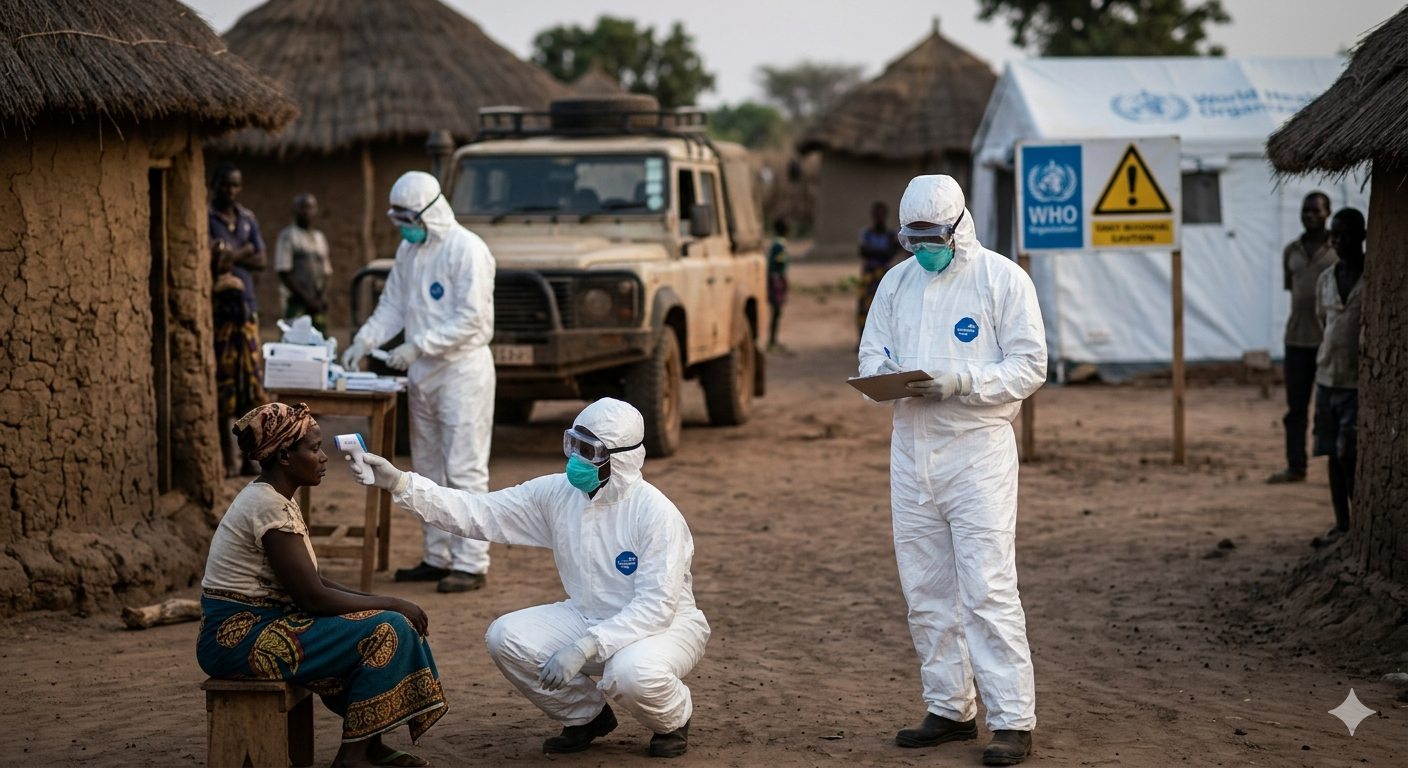
Ebola disease is a type of viral hemorrhagic fever and a severe infectious disease that can be transmitted through the blood and body fluids of an infected person. Early symptoms may begin in a way similar to other infectious diseases, such as fever, muscle pain, headache, and fatigue, but as the illness progresses it may worsen to vomiting, diarrhea, abdominal pain, rash, bleeding, and organ injury.
The May 2026 outbreak is especially notable because it involves Bundibugyo Ebola. Approved vaccines and treatments exist for Zaire ebolavirus, but international health authorities state that there is no approved vaccine or specific treatment for Bundibugyo virus, the cause of this outbreak. However, early supportive care, including fluids, symptom control, and treatment of complications, is a key response that can improve the chance of survival.

Basic Information on the 2026 Ebola Outbreak
Current Outbreak Status
| Category | Confirmed information | Meaning |
|---|---|---|
| Affected countries | Democratic Republic of the Congo, Uganda | Related cases have been confirmed after the outbreak began in eastern DR Congo and crossed the border |
| DR Congo count | 121 confirmed cases, 1,077 suspected cases, 17 confirmed deaths, and 238 suspected deaths reported | Confirmed and suspected cases together can be interpreted as 1,198 cases, with deaths totaling 255 |
| Uganda count | 7 confirmed cases and 1 death reported | Risk related to travel and contact with DR Congo has been identified |
| WHO assessment | Public Health Emergency of International Concern (PHEIC) | Assessed as a level requiring international coordination and preparedness in surrounding countries |
| Domestic response | "Attention" alert level and expanded areas subject to enhanced quarantine management | The possibility of importation into Korea is assessed as low, but quarantine and surveillance have been strengthened |
Why This Outbreak Is Considered Risky
Bundibugyo Virus
This outbreak is Bundibugyo Ebola, not Zaire Ebola. Existing Zaire ebolavirus vaccines are not considered effective for this type, and authorities state that there is no approved specific treatment.
Areas Affected by Conflict and Movement
The affected areas are places where humanitarian crises, insecurity, and population movement overlap. As contact tracing, isolation, safe burials, and protection of healthcare workers become more difficult, interrupting transmission also becomes more difficult.
Cases Across Borders
Related confirmed cases have also been reported in Uganda. In areas with frequent cross-border movement, one country's response alone may not be sufficient, so border screening and joint response by neighboring countries become important.
Increase in Suspected Cases
Suspected cases and death reports, as well as confirmed cases, are rising quickly. Suspected cases may be reclassified depending on test results, but in the field response they need to be broadly traced and isolated.
Main Symptoms of Ebola
The illness may begin with symptoms similar to a cold or other febrile illness, such as fever, headache, muscle pain, joint pain, fatigue, and weakness.
As the illness progresses, vomiting, diarrhea, abdominal pain, rash, chest pain, shortness of breath, and sore throat may occur. Dehydration and electrolyte imbalance can also be dangerous.
Unexplained bleeding, bloody stool, bleeding gums, nosebleeds, reduced consciousness, or signs of shock may indicate worsening severe disease.
The time from exposure to symptom onset is usually described as 2 to 21 days. This is why health status should be monitored for 21 days after visiting an affected area.
Routes of Infection and Contact to Avoid
It is not an infectious disease that spreads easily through the air.
Ebola can be transmitted after an infected person begins showing symptoms, through direct contact with body fluids such as blood, vomit, feces, urine, saliva, sweat, and semen. It is not generally transmitted simply by passing through the same space.
Contact with body fluids from patients and deceased persons is the highest-risk exposure.
Caring for a patient without protective equipment, directly touching a body during a funeral, or touching objects contaminated with body fluids can greatly increase the risk of infection.
Contact with wild animals should also be avoided.
Contact with wild animals such as fruit bats and primates, or eating wild animal meat, can increase the risk of infectious disease. In affected areas, it is important to avoid bushmeat and eat safe food that has been thoroughly cooked.
Domestic Response and Pre-Travel Checks
| Item | Details | What to check |
|---|---|---|
| Alert level | Korea Disease Control and Prevention Agency alert at the "attention" level | Possibility of domestic importation is considered low, while preparedness systems are reviewed |
| Enhanced quarantine management areas | DR Congo, Uganda, South Sudan, Ethiopia, Rwanda | Strengthened quarantine for entrants from affected countries and neighboring countries |
| Travel advisory | Travel ban adjustment for Ituri Province in DR Congo | Check Ministry of Foreign Affairs travel advisories before visiting |
| After returning | Check for symptoms such as fever, abdominal pain, vomiting, diarrhea, and bleeding for 21 days | If suspected symptoms occur, report to 1339 or a public health center |
Risk during ordinary daily life in Korea is assessed as low.
Ebola is not an infectious disease that spreads easily through ordinary contact like a respiratory virus. However, the level of risk may differ for visitors to affected areas, local medical or relief workers, and people who have had contact with the body fluids of a patient or deceased person, so they should check their health status after returning.
Personal Prevention Measures
Postponing nonessential visits is the safest option. If travel is unavoidable, check overseas infectious disease information from the Korea Disease Control and Prevention Agency and travel advisories from the Ministry of Foreign Affairs before departure.
Do not have direct contact with a patient's body fluids, such as blood, vomit, urine, feces, or saliva. Touching a body at a funeral should also be avoided.
It is advisable to avoid contact with wild animals such as fruit bats, monkeys, and chimpanzees, and not to eat wild animal meat.
If fever, abdominal pain, diarrhea, vomiting, or bleeding symptoms occur within 21 days after visiting an affected area, contact 1339 or a public health center first.
Frequently Asked Questions
Q. Is the 2026 Ebola outbreak actually a WHO emergency?
A. Yes. On May 17, 2026, WHO assessed the Bundibugyo Ebola outbreak in DR Congo and Uganda as a Public Health Emergency of International Concern (PHEIC). However, it stated that the situation does not meet the criteria for a pandemic emergency.
Q. Can this virus be prevented with existing vaccines?
A. This outbreak is Bundibugyo virus. International health authorities state that Zaire ebolavirus vaccines are not considered effective for the 2026 Bundibugyo outbreak.
Q. Is Ebola transmitted through the air?
A. It is not a disease that spreads like a typical airborne infection. The risk increases with direct contact with the blood or body fluids of a symptomatic patient or deceased person, or with objects contaminated with body fluids.
Q. What symptoms should raise concern?
A. If fever, severe weakness, muscle pain, headache, vomiting, diarrhea, abdominal pain, rash, or unexplained bleeding occurs within 21 days after visiting an affected area, immediate reporting and medical care are needed.
Q. How is Korea responding?
A. The Korea Disease Control and Prevention Agency assesses the possibility of domestic importation as low, but it has issued an alert at the "attention" level and strengthened quarantine by designating DR Congo, Uganda, South Sudan, Ethiopia, and Rwanda as areas subject to enhanced quarantine management.
Conclusion
The May 2026 Ebola outbreak in Central Africa is not simply overseas infectious disease news. International health authorities are responding strongly because several factors overlap: a rare type called Bundibugyo virus, the absence of an approved vaccine and specific treatment, affected areas where conflict and movement intersect, and cases that have crossed borders.
However, Ebola is a disease whose risk increases with direct contact with the blood and body fluids of infected or deceased persons. It is not an infectious disease that spreads easily through ordinary daily contact or simply walking along a street. More important than fear are avoiding visits to affected areas, avoiding contact with body fluids from patients and bodies, avoiding contact with wild animals, and monitoring health for 21 days after returning.
If you plan to visit Africa, or if symptoms such as fever, vomiting, diarrhea, abdominal pain, or bleeding occur after returning from an affected area, contact 1339 or a public health center before going directly to a medical facility. Because the latest outbreak status can continue to change, it is safer to check guidance from the Korea Disease Control and Prevention Agency and WHO.